

Military Sexual Assault: A Very Personal Issue for My Family
Incidents are increasing; no one is immune

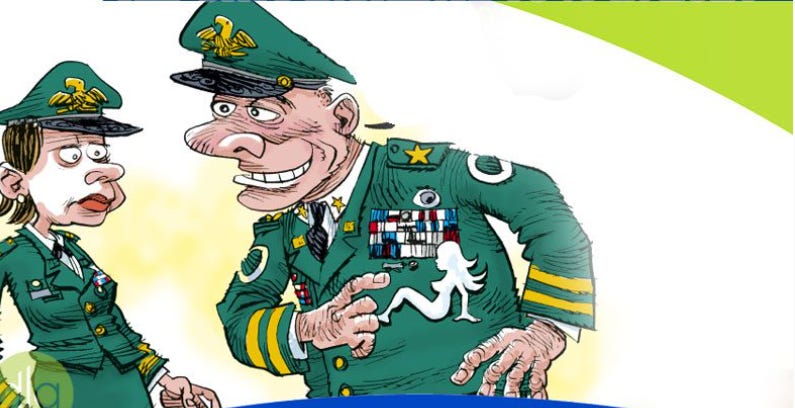
Hello, Inkspired fans, for the month of US Veterans Day, I want to reshare this important story with you. My family was deeply involved, and the consequences of these events are always horrendous. The story is difficult to read, but so important to understand.
Google these three words, browse the results, and you will feel like throwing up: headlines rape military.
Right now, the United States (and some European Countries) is in the midst of an escalating epidemic of sexual abuse of women who serve our country. And I promise you—the epidemic can touch your life without warning or provocation. I’ll tell you what you can do to advocate for yourself or a loved one. I wish I could tell you how to survive without scars, but I can’t.
From an opinion piece, USA Today, April 2023: The percentage of women in the military who were sexually assaulted in 2021 spiked to the highest level since the Defense Department started tracking the statistic, according to new data.
Depending on who you read and how many military members they interviewed, sexual assault statistics range from an intolerable 8% to an incomprehensible 25% of military women. It happens to substantially fewer men, but the number is still tragic and disgusting. We’re talking tens of thousands annually and rising.
The US Department of Defense agrees, “…female troops…and…male troops said they were assaulted while on duty during the past calendar year, the department’s annual 2021 report shows based on surveys of service members.”
There’s a ray of hope: “The number of sexual assault reports filed by victims with military authorities—the other key metric used by the department to gauge the scope of the problem—also jumped about 15% from the previous year.” The increase could mean more women are getting braver and reporting.
If you’re feeling sick and disgusted, you should be; and consider further that a staggering “41.1% of women veterans say they experienced sexual harassment without physical assault,” a situation that receives even less reaction from the military and the public (USA Today). The actual number could be even higher since many survivors of both kinds of attacks never report their experience. Service members, male and female, say they don’t trust any branch of the military to protect them.
Women are often victimized more than once
Can you imagine how it must feel to be a victim of rape? No, you can’t. Now think about surviving two rapes—each perpetrated by a trusted supervisor. I will tell you a true personal story from some years ago, with real consequences today. I am very connected to the woman who survived these events. Seventeen-year-old Beth was on active duty with the U.S. Navy. Her assailants, both supervisors, outranked her. Getting help and justice took intense tenacity and occurred more than a year after the second rape. Keep going for her whole story.
Anybody can fall victim to military rape
Beth entered the Navy two days after high school graduation. Eager and excited about serving her country, she knew she could become an officer and make a difference. She felt ready to endure anything to make the grade. Beth learned quickly that the military is male-centric, but she had the right stuff to stay focused and succeed. She had wanted the Navy for a career since the fifth grade.
Beth didn’t join the military because she couldn’t do anything else. A major pharmaceutical company had awarded her a full-boat, 4-year college scholarship. She turned it down. In boot camp, Beth stood out as an achiever with a professional attitude. In her post-boot camp training school, she chose a career path most women wouldn’t pick. She wanted to work with aircraft and maybe someday qualify as a Blue Angel, so she became an aviation technician. Excellent school record. Outstanding participation. She snagged a choice assignment for her first duty station, and off she went into her wild blue career future.
On base, as a rookie, she worked well with peers and superiors, taking teasing in stride and keeping her eye on her goals. Everyone liked her. No complaints from her or about her. She volunteered for activities and extra duty and began assembling her officer qualification package. Always outgoing, she had a healthy social life, too. There were parties, group activities, and a great relationship developing with a new boyfriend. Life was good.
And the terror begins.
It was Christmas Eve, the third Christmas in a row she was separated from her family. Her boyfriend was away on temporary duty. For Beth, Christmas had always been a bigger-than-life event full of fun, a big extended family, lots of presents, and great food. This time, it was a horror story. Beth, hoping for a distraction, heard a big party was planned. Too young to drink and too busy to deal with hangovers, she was the designated driver for a group of friends.
Late in the evening, Beth noticed a guy she knew, her boyfriend’s roommate, getting pretty drunk. He was a petty officer and her supervisor, so she was concerned for him. He kept drinking, and someone pocketed his car keys. As the party wound down, Beth poured him into her car, laughing at his antics, and drove him home after dropping off her other friends. Half dragging, half pushing him into his apartment, she dumped him into his bed—leaving him in street clothes. She tossed a blanket over him and thought, “He will not feel good in the morning.”
Tired, she left the roommate to sleep it off and decided to sleep in her boyfriend’s empty bedroom on the other side of the apartment.
In the middle of the night, Beth jerked awake, startled to find the roommate on top of her in the act of sexual penetration. She struggled and yelled, “STOP IT.” She tried to push him off. She failed.
Don’t make the team look bad, Sailor
The attack frightened and traumatized her so much that she couldn’t even bring herself to tell her parents, whom she trusted without reservation. For a week, Beth often cried, overcome by embarrassment, fear, and emotional turmoil. Beth decided to tell someone, so she went to the Master Chief. He was nice, she recalls. Pleasant. But his message was clear.
“You waited several days to step forward,” he told her. “It’ll be a he-said, she-said. Your word against his.”
Remember, the perpetrator outranked her as a supervisor in her unit. The chief pointed out that the whole team would suffer if Beth made a big deal about this without proof or witnesses. Everyone would look bad. Did she want to do that?
Like many teens, Beth thought authority figures were on her side and would give her the best advice. She decided to let the matter rest to avoid any further trauma. She never felt right about that choice. Beth recalls, “My decision to not prosecute was not good, looking back. But I cared about my command and was concerned about how a prosecution would reflect on everyone. After all, I had no proof. No rape kit.”
A 17-year-old child who had never been away from her supportive family before, she felt she was expected to be grown up. Strong. Beth was a sailor and wanted to be an officer. The Navy made it clear from boot camp that you respect the chain of command and do as you’re told. Master Chief made it clear she could end up with a black mark on her record. Of course, he was nice about it. Empathetic. Beth dropped the issue and went back to work.
It wasn’t easy. She looked over her shoulder constantly. She got icy stares from her attacker and his friends. He was still her supervisor, and he controlled her life. Word had gotten around that she ratted him out. The creep told everyone she had “wanted” him all night long. Beth tried to heal with support from her family, but they were far away. The Navy offered her nothing — no counseling, understanding, medical help, or transfer to another supervisor. That happens to many women. These women are often young, inexperienced, and far from their support networks.
And the nightmare was far from over.
Attack number two: same unit, different supervisor
Beth heard she was being sent on temporary duty with her team to an island paradise. She looked forward to the distraction, but before long, paradise became hell. A week after arriving at the new station on the Island of Crete, a group of sailors, including Beth and 40-year-old supervisor Petty Officer Martino, went off base for a weekend. They booked several hotel rooms as a group, though they had been told to sleep on base. This wasn’t uncommon. The group was mixed, men and women of various ages. Martino was significantly older than most of the team, and it wasn’t common for a supervisor to go off partying with the team.
Martino, a known rule-breaker with a reputation for risky behavior, often came on strong to young women and was often rebuffed. He was married and had children. Witnesses said he bragged he’d “get it on” with Beth. The man was middle-aged, overweight, with a bad complexion. Why would a teenager want him? Later, the prosecutor in a court martial would ask the court to ponder that question. It should be noted that military culture sets an expectation that women see themselves as strong and able to meet all challenges.
Soon, Beth felt worried about breaking the rules and worried about the consequences. The evening had been boring, and there was some acting out. She wasn’t party-minded anyway, so she returned to the room she shared with two girls who were both still out around town.
Beth was asleep when Martino entered her room with a key he later said someone gave him. For the second time in half a year, Beth woke to a man raping her. She struggled, slapped, hit, kicked. She shrieked, shoving the large man off and onto the floor. She said later she had no idea where the burst of strength came from, but she remembered thinking, Oh HELL no!
She fought with a burst of adrenaline. Beth screamed and shrieked for help, flung the door open and ran, pounding on doors (still screaming), and finally latched onto a female co-worker. Clinging, Beth gasped, “I need the police and a doctor.”
Hurt. Stunned. Terrified. Pissed off. Finally, pissed off.
Beth reported to the police, the command, another supervisor, and anyone who would listen. Over time, evidence was gathered, including a rape kit, and ultimately, a court martial convened in Rota, Spain, where Beth’s unit had been based.
The Navy finally offers help: too little, too late
Beth made civilian and military police reports and was taken to the hospital, where a male Senior Chief met her. She had a rape exam and was questioned. Martino never claimed she consented. He said, with hubris, “I knew she wanted me.”
The next day, the main base commander ordered everyone back to the home base in Rota. He gave Beth the phone number of a SAVI counselor (Sexual Assault Victim Intervention). SAVI advocates for survivors of sex crimes; they have recently been renamed Sexual Assault Prevention and Response. They can accompany a survivor to meetings or appearances she feels uncomfortable about. SAVI workers are supposed to make sure survivors get services. Sometimes months pass before SAVI is available. Sometimes, they don’t do their job at all. Sometimes, a base doesn’t even have a counselor.
Beth recalls, “This particular counselor told me it would be helpful if I testified, but I couldn’t be made to do it. I thought long and hard through months of nightmares, fear of walking across the base, fear of going to work, and fear of staying in my own house at night. I tried to get mental health counseling, but the Navy and civilian medical staff were overbooked. My female supervisor and a close female friend stayed with me in my house for months.”
When those women were unavailable, Beth stayed with a married couple. It didn’t help. She decided to get her case in front of a court martial. For months, chunks of her days were spent in interviews by JAG (Judge Advocate General’s Corp). They were all men, not unkind, but not easy to talk to. She gave hours and hours of depositions. Beth was asked to wear a recording device, phone her attacker, and talk about the incident.
She saw him daily at work; no job change had been available.
Beth said, “Every time I was interviewed or testified, I was shaken to my roots for days. Terrified. Distraught. I once saw the attacker as I drove across the base, and I hid under the dashboard of my car for over an hour until I was sure he was gone. I had to hear and read the most awful things he and his wife said about me—do you know what that’s like? To have someone ranting lies about your character and your person—in public?”
This case was only unusual in that the command made an effort to move the complaint forward. Most women encountered roadblocks at every step and soon give up. Beth’s courage and tenacity were not the norms.
The Navy tried, but not hard enough. Beth told her family weeks later that she hadn’t seen a local doctor. She couldn’t get off work. She received no mental health intervention for the same reason and worked with Martino daily. Male co-workers shunned her. Gossip was rampant. Imagine an 18-year-old enduring that.
The wheels grind slowly and then stop
For a while, there was no more progress in her case. Beth found support from her family when the Navy left her adrift. Her mother spent every day at home researching similar cases. She made phone calls all the way to Washington, D.C., and wrote letters. Slowly, Beth got some services but never got everything a rape victim should have, including care for post-traumatic stress. Other military women report similar situations—some stories are even worse.
Fear blanketed Beth days. Noises made her jump. She didn’t sleep much for a long time. She bought a very large dog, which helped some, but she still felt exhausted and confused. She ended up being temporarily reassigned to clerical duty and losing months of practice in her own specialty. Her career was permanently derailed. As for her attacker, he went about business as usual. It took two years of wrangling with the Department of the Navy, SAVI, and other players to resolve the case.
Ultimately, Beth was sent to Key West, Florida, to negotiate medical retirement, something she did not want. Now 19, she made the difficult decision to return to Rota and testify in the court martial. She flew alone and waited three days to be called on. Beth testified for five grueling, terrible hours—facing her rapist. His wife sat and glared at Beth for all those hours.
“I felt for her as a person,” Beth said. “I understood the impact a guilty verdict would have on her life, on his children. I shook all day and all night. But I did the right thing. Other women (and I) deserve to be safe. My attacker took away the safety. I did it because I knew I would be angry with myself if I didn’t.”
After she testified, Beth could not get air into her lungs—she thought she was dying. She was a mess on the plane and thought about calling an emergency doctor. Was she having a heart attack? That is what it feels like to be a survivor of rape—one rape. To have endured two within weeks of each other could destroy a victim.
Beth’s recovery and her future as a survivor
The base change began the healing, putting Beth closer to her family and ensuring medical and mental health assistance. The Navy should have addressed Beth’s duty location immediately after the attack, but that never happens. Other military branches are no better. The Navy’s failure to be proactive, indeed, their failure to address this sexual misconduct pandemic, causes survivors to suffer mental and physical problems like
PTSD
Self-medication
Sleeplessness and night terrors
Unexplainable physical symptoms, including headaches, gastric distress, heart problems, and muscle problems
Low self-esteem
Anxiety and depression
Loss of income and career
Isolation
Women like Beth often go into their careers with high expectations for themselves. They hold themselves to a high level of performance and feel lost when they can’t maintain it. For years, they may perform properly, at times, but then are sabotaged by their challenges. For ten years, Beth was certain her attacker would come looking for her or send someone to find her. One of the survivors’ biggest issues is taking back control of life, feelings, and fears. They do better living with family, not strangers until they reform the emotional connections that create trust. Beth noticed her palms sweating and her heart jumping as she retold her story. She felt lightheaded. Some survivors never recover completely, but they will not likely progress in the military environment.
A decade later, Beth has permanent emotional distress, anxiety, and trust issues. Through her courage in testifying for five hours, her assailant was convicted, demoted, dishonorably discharged, and put in prison. The prosecutor said he had not seen another conviction in 20 years. He commented that almost no one receives prison time. Martino is in Leavenworth.
Beth received a medical disability discharge but was subjected to the typical hostility, ridicule, and accusations on many levels as she fought, refusing to yield. Though the military code is “never leave a fallen comrade,” the male-dominated military doesn’t see a psychologically injured woman as fallen—or as a comrade.
Beth is now a mother to six awesome kids. She has overcome many of the problems directly attributable to her trauma. She still has a big dog, her husband has to help her through anxiety attacks, and a few relationships did not survive her recovery process. But Beth is whole, with a few scars; she earned a master’s degree in psychology but has never been able to work. She hopes to counsel survivors at some point. Beth’s eldest son is a senior in high school, and last week, he joined the Navy.
How Beth got help—what a survivor can do
Beth’s mother emailed the base commander, requesting assistance for Beth as a rape survivor. People told her not to “interfere,” but that action jump-started the court process. Every victim should find an advocate who cares about her.
Mom contacted the SAVI Program Manager requesting help. SAVI is now SAPR (Sexual Assault Prevention and Response). Partially because of that contact, there is now a Safe Help Hotline at 877–995–5247.
Beth insisted, through the chain of command, in writing, that she be transferred away from her attacker.
Beth contacted the Command Master Chief at each base once she was transferred away from Martino. She requested time to pursue medical and mental health appointments during working hours.
She wrote to her Congressional Representative, filing a written request for assistance. Her request for transfer and separation had frozen on a Navy desk. The Congressional representative was able to get it moving again.
She saw civilian physicians to document her condition at the Navy’s expense.
She sought counseling through a civilian rape crisis organization and asked them to document her issues in writing for her command.
Beth visited the Navy legal office to determine what kind of assistance they could offer. She insisted on filing charges and testifying against her attacker.
She wrote to the Miles Foundation, a national advocate providing assistance for military survivors of sexual crimes.
She contacted civilian legal representatives who work with separation concerns. They can often answer questions about soldiers’ rights.
What YOU must do
Read and study the Uniform Code of Military Justice to understand policies on sexual crimes. If you are raped or attacked, make a lot of noise, report to authorities (civilian and military police), seek medical attention and document every step in writing. Don’t give in to pressure. Seek legal help. Here’s a fact sheet from ProtectOurDefenders.com that will help you understand the importance of standing strong.
Speak up and find help. Pursue medical and mental health assistance. Testify against your attacker. If a man rapes, he will rape again. Victims of rape, whether military or not, for some reason have a statistically huge chance of being raped again. Persevere. Know it wasn’t your fault, and you will recover with time.
Whether or not you are a survivor, write to your Congressional Representative and demand closer scrutiny of sexual misconduct in our military. Every citizen has this obligation to protect the people who volunteer to serve our nation.
You can find some good resources at WoundedTimes for PTSD help.
If you enjoy what I have to say and you identify as a writer, be sure to investigate my sister-pub Pen2Profit.
Great article. My heart goes out to her and I'm glad she has a supportive family.
I don't have much knowledge about the situation in the military, but I've experienced the anxiety of these survivors as partners up close in my relationships in the civilian world. It's way too common everywhere, but the military has a responsibility to take a zero tolerance attitude. I can't see that happening under the current regime.
I'm not a fan of our mass incarceration system, but these crimes are a major exception. We need to clear out minor drug offenders from prisons so that we can impose much longer penalties on sexual assault criminals. And men need to instill in their sons unshakable respect towards women.
A lot of young boys and early adult men are listening to misogynistic podcasts on the regular, too. We are developing a media culture that grooms this behavior. I don't see much counter programming to it, unfortunately.
Dear Maryan, what you describe is terrible. This serious problem likely occurs in many countries and, due to a lack of reporting, goes unrecognized. Thank you for sharing it.