

The Secret Soundtrack of My Slightly Scandalous Youth
Ten albums from the early 70s that changed everything

I remember precisely what I was doing when I heard the news about Kent State. And when Janis died, I was driving to Southern Illinois for a concert (maybe Santana?) and a sit-in.
Here’s what I want to know: do you remember where you were the first time you heard Tapestry?
I was sprawled across a beanbag chair—harvest gold, naturally—in my college roommate’s new apartment, eating cold SpaghettiOs from a can and pretending I was not thinking about a certain someone who had not called me back. I drew a five-foot-high candle on the walls of that place, with smoke tendrils that curled and curved all the way around the dining room. She did not get her security deposit back.
Anyway, Carole King came on the turntable, and I didn’t move for the rest of the side. By the time It’s Too Late finished, I had composed myself, finished the Os, started on a jar of beets, and decided I was absolutely fine now.
(I was not fine. But the music helped.)
That was 1971. And the early ‘70s—roughly 1970 to 1975, if we’re being generous with the bookends—produced what I believe is the most extraordinary cluster of albums in the history of recorded music. I’m not being sentimental. Well. I’m being a little sentimental. But I’m also right.
You want to argue that point? What do you think the comments section is for?
Here are ten of those albums why they mattered then and still do.
Tapestry — Carole King (1971)
Let’s start here, because everything should start here. Carole King spent years writing hits for other people—Will You Love Me Tomorrow, Up on the Roof—and then she sat down and wrote an avalanche of hits for herself.
The result was an album that sold 25 million copies and permanently changed what a woman singer-songwriter could be and could say out loud. Remember?
It was intimate in a way that felt almost intrusive. Like overhearing your most centered friend admit she was quietly falling apart. I played my copy until the grooves practically flattened. It taught me, at twenty-something, that you could be honest about heartbreak and still express true self-respect. That was a lesson I needed more than once.
What was I doing while it played? Crying. Cleaning my apartment. Crying while cleaning my apartment. Writing letters I wouldn’t send. Planning to burn my bra. You know how it was.
What’s Going On — Marvin Gaye (1971)
Motown did not want to release this record. They thought it was too political, too jazzy, too strange. Marvin Gaye released it anyway, and it became one of the most important albums ever made—a meditation on Vietnam, addiction, environmental destruction, and spiritual longing, wrapped in the most gorgeous, layered, heartbreaking sound I had heard up to that point in my life.
It is still astonishing. Put it on today, and you will feel it in your chest within thirty seconds. I promise.
What was I doing while it played? Some days, marching. Some days trying to explain to my parents why I was marching. (That particular conversation never went especially well. Lord, my repressed father hated the 70s.) Some nights, I just sat quietly in the dark with it on, because some music you simply do not talk over.
Led Zeppelin IV — Led Zeppelin (1971)
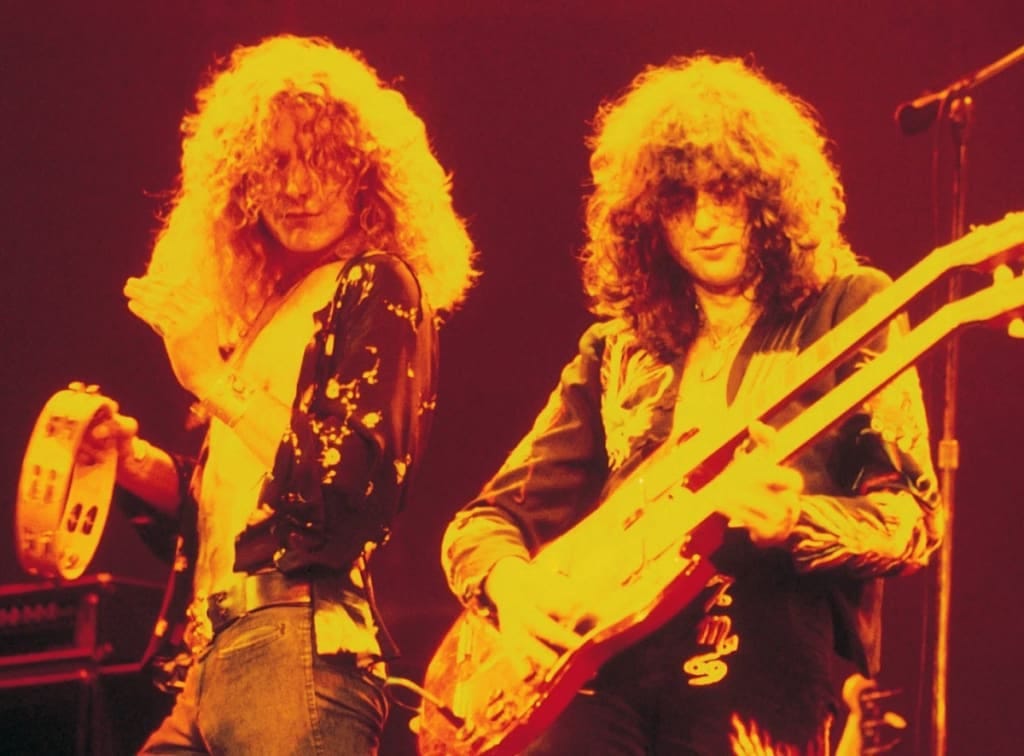
No title. No track listing on the outer sleeve. Four mysterious symbols. And inside: Black Dog, Rock and Roll, The Battle of Evermore, and Stairway to Heaven—which played on every FM rock station approximately every forty-five minutes for the next decade, and none of us objected.
(It remains a magnificent song, despite everything that has since happened to it.)
I remember the first time I heard Black Dog come out of a decent set of speakers at full volume. I stood still for a moment, recalibrated my entire understanding of what a rock band could do, and then got on with my evening. There was a lot of evening to get on with in those days. …that cloud of smoke…
What was I doing while it played? Driving too fast. Air guitaring when I thought no one was looking. (Someone was usually looking. I did not care.)
Exile on Main St. — The Rolling Stones (1972)
A double album recorded in a rented villa in the south of France while everyone involved was, let’s say, extremely committed to the rock and roll lifestyle. It sounds like it was recorded in a basement at 3 a.m. That is precisely why it’s perfect—muddy, sprawling, joyful, falling apart in all the right ways.
I have a theory that Exile is the album you appreciate most in your thirties, once you’ve lived enough to understand that beautiful things are often slightly chaotic and held together with duct tape. At twenty-two, I thought it was a mess. At thirty-two I understood it was a masterpiece. I’ve been right about it ever since. Wait, you’re not arguing again, are you?
What was I doing while it played? At a party. Always at a party. Or a club or concert (my first was Herman’s Hermits when I was, I dunno, 13?) Or wishing I was at a party.
Harvest — Neil Young (1972)
The most successful album Neil Young ever made, which seemed to embarrass him somewhat—he promptly pivoted to making a series of deliberately uncommercial records that confused everyone. (Classic Neil.) But Harvest is beautiful: lonely and warm at the same time, like a campfire in a field in November. Heart of Gold went to number one and deserved every week it spent there.
I played this one alone, mostly. There’s something about Neil Young’s voice—that particular fragile quality—that makes company feel like an intrusion. Know this, I was playing that album yesterday, and I still love his craggy, poignant voice.
What was I doing while it played? Reading. Thinking deep thoughts. Trying to seem deeper than I was. (Successfully, some of the time.) Getting stoned. Yeah, sue me.
Innervisions — Stevie Wonder (1973)
When Stevie Wonder turned 21, he renegotiated his Motown contract and took complete creative control. Then he made five consecutive masterpiece albums. Innervisions was the third—Living for the City, Higher Ground (love that SONG!), Too High—and it is a work of such confident, joyful, furious genius that it still makes me slightly regretful about everything I probably should have accomplished.
(I mean that in the most affectionate way possible.)
The first time I heard Living for the City I cranked the volume in my apartment and danced around my kitchen, naked. My downstairs neighbor knocked on the ceiling with what I assumed was a broom handle. I turned it down approximately three percent. Eff u, neighbor.
What was I doing while it played? Always dancing. There was no other appropriate response.
Court and Spark — Joni Mitchell (1974)
Joni Mitchell made experimental records. She made more critically praised records. But Court and Spark is the one where everything came together: the jazz influences, the autobiographical lyrics, the strange open guitar tunings, the voice that could do things no other voice could do. The sound feels like Los Angeles in the early ‘70s—if Los Angeles was freedom and impending heartbreak and jasmine.
(It kind of was, actually.)
I have never fully recovered from The Last Time I Saw Richard. If you know, you know.
What was I doing while it played? Falling in love. Falling out of love. Writing in my journal about both. Sometimes all in the same week. I was nothing if not efficient.
The Dark Side of the Moon — Pink Floyd (1973)
This album stayed on the Billboard charts for 937 weeks. Nine hundred and thirty-seven. It deals with time, mortality, mental illness, and the particular madness of modern life, and it does so with such precision and atmosphere that it functions as a complete theatrical experience unto itself. Yeah, okay, that’s a little over the top.
The first time I heard it all the way through—really sat down and listened, beginning to end—I was quiet afterward for a solid minute. Which, for me, in my mid-twenties, was somewhat unprecedented. Still is.
What was I doing while it played? Staring at the ceiling. Contemplating the universe and my navel. Eating whatever snacks were available. (I will neither confirm nor deny the precise circumstances under which some of us first encountered this album. Suffice it to say the ceiling was very interesting.)
Goodbye Yellow Brick Road — Elton John (1973)
Elton John in 1973 was a phenomenon—releasing multiple albums a year and somehow landing at least three permanent residents of your brain on every single one. Goodbye Yellow Brick Road was a double album, a whole gorgeous extravagant world, and it contained Candle in the Wind and Bennie and the Jets and the title track and Saturday Night’s Alright (for Fighting) and it is almost unfair that one record is allowed to do all of that.
(Bernie Taupin wrote those lyrics, by the way. I have been wanting to hand that man a flower for fifty years, and I’m doing it now.)
I sang along to every word of this album, constantly, at full volume, without apology. I stand by this.
What was I doing while it played? Everything. Getting dressed. Driving. Pretending I wasn’t singing along. (I was always singing along.)
Who’s Next — The Who (1971)
I’d be doing a disservice to the decade—and to my own memories—if I left out the album that begins with the sound of Roger Daltrey zipping up his fly and Pete Townshend hitting one of the most iconic opening chords in rock history. Baba O’Riley. The synthesizer rising like something being built from the ground up, and then the guitars come in, and then that voice.
I saw The Who perform twice in the early ‘70s. Both times I left partially deaf and entirely exhilarated, which I maintain is the correct way to experience them. Behind Blue Eyes, Bargain, Won’t Get Fooled Again—this album is a complete education in what rock and roll can do when it decides to be serious about itself.
What was I doing while it played? Standing up. You could not sit down for this record. Still can’t.
What it all adds up to
Here’s what strikes me, looking back at this list from the comfortable vantage point of seventy-six years and several superb decades: that music wasn’t background. It was the texture and soundtrack of life itself.
We didn’t stream it. We didn’t skip tracks. We put a diamond down on vinyl and we listened—because albums cost money we often didn’t have and because the album was a thing, a complete thing, with intention and sequence and weight.
I knew every word of every song on records I loved, and I have never forgotten those lyrics. I handed them to people I was falling for like I was handing them something essential about myself.
(Because I was.)
I haven’t included Janis Joplin, because it’s still too sad for me—she was my soulmate in spirit if not in person. Every time I played PIece of My Heart, my BFF jumped up on the coffee table, grabbed a candleholder for a mic and did Janis better than Janis did.
I still have most of those albums—not the vinyl, long gone through various moves and lend-and-never-returns. Don’t get me started about the asshat who borrowed Alice’s Restaurant and then moved away…
…but I have the memories of them, which turn out to be almost the same thing.
Put on What’s Going On sometime. Put on Court and Spark. Put on Baba O’Riley and try, I dare you, not to feel something shift in your personal essence.
We were young and searching and absolutely certain we understood everything. The music knew better, and it told us so, and we loved it for that.
I still do.
Did I ever tell you about the weekend I came home from Northern Illinois University, dressed in buckskin, fringe, and beads from head to toe, and my dad offered me $50 (FIFTY BUCKS!) to burn the clothes? I sneered “no” with total reverence for the counterculture. But that’s another story.
Inkspired is where I come to talk about the things that stick—the music, the moments, the lessons that took decades to fully land. If this sent you down a rabbit hole of old records, I’ll count that as time well spent. If you want to learn how to write about the soundtrack of your life, drop in at Pen2Profit on Substack.
Love this! My jukebox brain went a little nuts while I was reading about these albums. The music carried us, didn't it? I would have to add Let it Be to my list, though. I was twelve when it came out, and it changed the way I thought.
I'm going to have to put on some Zeppelin or Stevie Wonder soon!
I am right there with you Maryann. I still love the music of my young rebellious years. I am still proud to be called a hippie!